We use essential cookies to keep this site working — your cart, your accessibility settings, your preferences. We don’t use tracking or advertising cookies. Read our Cookie Policy.




Stephen Games
The publisher and editor of EnvelopeBooks and Booklaunch, Stephen Games is the author of fifteen nonfiction titles. He began his career as an architectural critic, working for the Journal of the Royal Institute of British Architects, freelancing for the Guardian as a correspondent, and being contracted to BBC Radio 3 as a documentary maker. After joining the start-up team of The Independent in 1986 and standing for Parliament as Green in 1992, he moved briefly to California where he became an opinion writer for the Los Angeles Times. Returning to the UK he published four books about Sir Nikolaus Pevsner and anpther four about Sir John Betjeman, and then became increasingly involved in books on other topics. He studied Graphic Design at the Central School of Art in London before taking an undergraduate degree in Architecture at Magdalene College, Cambridge. He has taught at universities in Britain and America, and holds a PhD from Cambridge.
Background
Stephen Games is a publisher, editor, writer and designer whose career has developed at the intersection of architecture, the visual arts, journalism, cultural commentary and books. He is best understood as an unusually hands-on independent publisher: rather than having entered publishing through the conventional editorial or commercial route, he arrived at it after several decades engaged in complementary activities.
Games’s early career was in journalism and criticism. He wrote for the New Statesman while at Cambridge and subsequently for The Listener and other publications; in 1979 he became deputy editor of the RIBA Journal and later architecture correspondent of the Guardian. He was also a documentary maker for BBC Radio and wrote opinion pieces for the Los Angeles Times.
His academic work has centred particularly on Nikolaus Pevsner, the German-born art historian who became one of the 20th century’s most influential interpreters of British and European architecture. In addition to his PhD and Volume One of his Pevsner biography, he has published several books that look at Pevsner’s radio broadcasts on architecture and the visual arts. He has also edited several collections of the writings of John Betjeman, another figure who made use of radio to bring architectural criticism to public attention.
This background matters to an understanding of Games as a publisher. He is not principally a commercial publisher with a fortuitous interest in the arts; his publishing activity grows out of a long-standing engagement with the way ideas are presented to a general readership. Design is equally important. His training in graphic design has informed both his editorial work and the unusually strong visual identity of his publishing ventures, most notably his cover designs.
In 2018 Games founded Booklaunch, a quarterly magazine devoted to new books. Its distinctive proposition was to reproduce substantial extracts from books that Games believed deserved a wider readership, alongside interviews, reviews and other literary material. The magazine developed the largest circulation of any books magazine in the UK, and gave rise to his next publishing venture, Envelope Books.
Games established EnvelopeBooks in 2020, during the pandemic. The original impetus came from Booklaunch readers who approached him for advice about publishing their own books. Rather than merely advising them, he decided to create a publishing house capable of taking on manuscripts that, in his view, had literary or intellectual merit but were unlikely to pass through the conventional machinery of agents and large publishers.
EnvelopeBooks was consequently deliberately presented as a generalist independent publisher. It published both fiction and non-fiction and did not organise its list around a conventional genre speciality. Its stated criterion was the quality of the writing and the strength of the ideas. The house says explicitly that manuscripts are assessed and then developed closely with their authors, with considerable emphasis on editing and clarity.
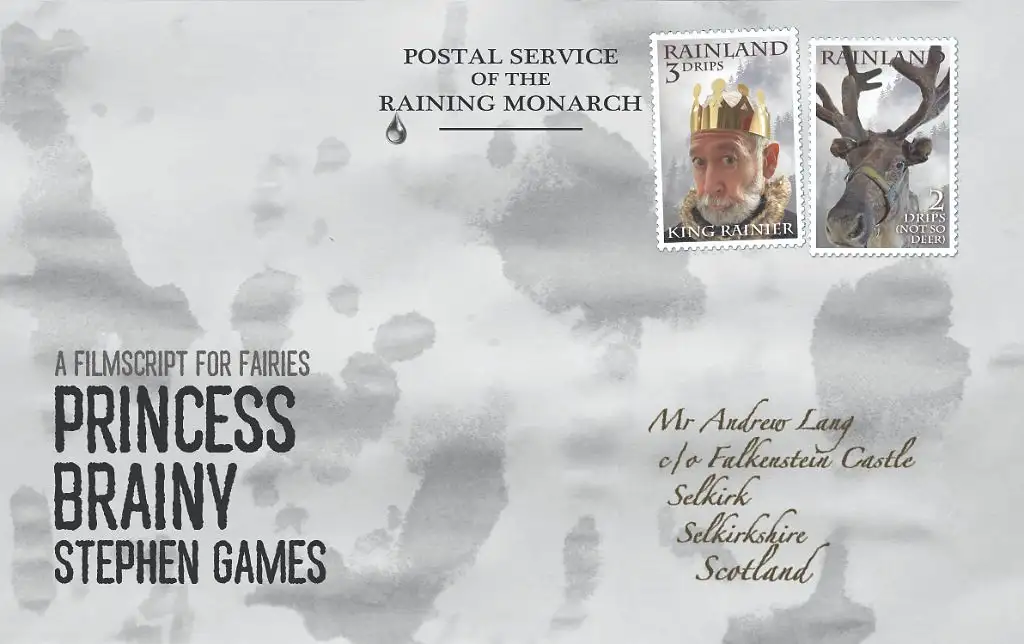
The physical identity of EnvelopeBooks is perhaps its most immediately recognisable feature. Games conceived of a book as ‘a letter from a writer to a reader’, and designed the books accordingly: their covers resemble envelopes and incorporate graphic clues relating to their contents. This is not merely decorative branding. It reflects Games’s longstanding interest in the relationship between graphic form and intellectual content, and his conviction that the physical book remains an important part of the reading experience.
The character of the list is similarly distinctive. EnvelopeBooks has published memoir, literary fiction, history, biography, travel, cultural criticism and books based upon unusual personal experience. The list includes, among others, George Tomaziu’s Artist Spy Prisoner, Jonathan Lawley’s A Road to Extinction, Marguerite Poland’s A Sin of Omission and a number of works by aspirant authors whose subjects would be difficult to place within a conventional commercial publishing programme.
There is therefore a strong element of curatorial publishing in Games’s approach. He is attracted to books with a strong individual voice or an unusual body of knowledge behind them, rather than books that fit readily into an established commercial category. His own account of the business makes the distinction quite explicit: he describes himself as ‘the antithesis of a professional publisher’ and says that EnvelopeBooks arose from a desire to help writers with strong manuscripts who had been unable to obtain conventional representation.
That description does not mean, however, that he lacks conventional publishing ambitions. On the contrary, he has spoken of wanting the books to be widely read and commercially successful, while retaining a recognisable visual identity and a degree of editorial independence. The tension between those ambitions—literary selectivity on the one hand and commercial reach on the other—is central to the character of the enterprise.
There is also a notable continuity between Games’s earlier career and his present role. As an architecture critic, broadcaster and writer on Pevsner and Betjeman, he was concerned with making specialised cultural knowledge intelligible without reducing its complexity. As a publisher, he applies much the same principle to books more generally. The emphasis on editing, in particular, is consistent with a career in which the quality of exposition has been as important as the subject itself.
The result is a publishing figure who occupies an unusual position in contemporary British publishing: part editor, part designer, part critic and part literary entrepreneur. His standing lies less in the scale of his publishing operation than in the distinctive editorial philosophy behind it. EnvelopeBooks represents an attempt to create a small publishing house in which the publisher’s personal judgement, editorial involvement and visual sensibility remain unusually prominent.
For that reason, Games is perhaps best regarded not simply as the proprietor of an independent press but as a traditional literary editor operating with the tools and freedoms of a modern micro-publisher. His career before publishing provides the intellectual background for that enterprise, while the books he now publishes demonstrate a continuing interest in writers who possess something distinctive to say but whose work does not necessarily fit the priorities of mainstream publishing.
More about this author
muckrack.com/stephen-games-1/bioBooks by this author