


-
×
 My Modern Movement
1 × £14.95
My Modern Movement
1 × £14.95
Subtotal: £14.95
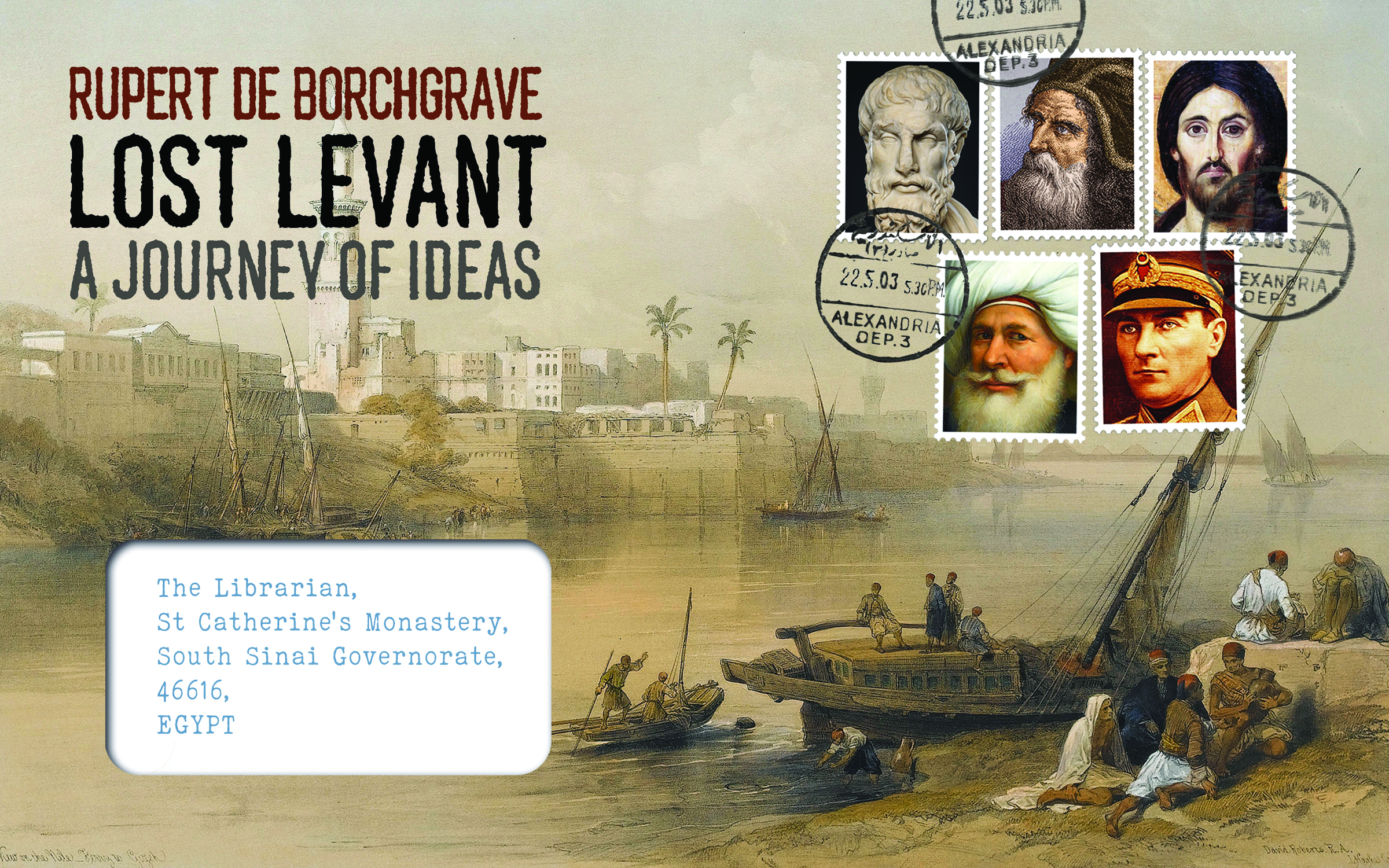
How do we understand the heritage of the Levant? In the last few hundred years, the centre of cultural innovation has moved inexorably westwards, leaving us with too small a grasp of the turmoil out of which our own civilisation grew. In 2003 Rupert de Borchgrave set off on a journey of ideas that took him to the much-disputed grounds where the ancient world constructed the philosophical, religious, mathematical and artistic thinking that continues to shape our lives today.
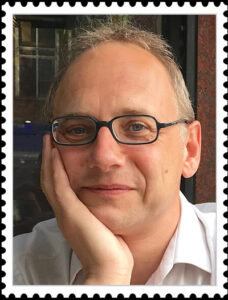
In his professional career, Rupert de Borchgrave has been variously a neuroscientist, applied statistician, securities analyst, government economic advisor, whistle blower, and most recently the manager of a technology fund.
Publisher: EnvelopeBooks
Extent: 496 pages
Size: 203mm x 127mm (8.0” x 5.0”)
ISBN: 9781915023513
“An ambitious achievement, dense with rich material, about parts of the world we once knew much about, which many readers will now want to discover for themselves on the back of this journey.”
Nicholas Shakespeare
Review of Lost Levant by James Howard-Johnston, emeritus fellow of Corpus Christi College, University of Oxford. Formerly University Lecturer in Byzantine studies.
Pages 52–54, The Pelican Record, 2025
There are many sub-genres of travel writing. At one extreme comes the writer open to every minuscule aspect of the lands he is visiting, ready, for example, to lie down and gaze at a mini-jungle of grass in the fertile Gurgan steppe in northern Iran. Then there is the adventurer in wild country who transforms ordeals into entertaining tales – and all those fine travellers who criss-crossed Asia and the Middle East in the eighteenth and nineteenth centuries, providing up-to-date accounts of peoples and places, and who collectively act as an invaluable source of information for historians about terrain, routes, resources and the social order of the localities. Observation rather than rumination is the metier of most, but some allow thoughts, whether those guiding their steps or those evoked by experiences on the way, to suffuse their accounts. None more so than Rupert de Borchgrave.
He set off from Paris in March 2003 just before the start of the Gulf War (against which he had demonstrated, unlike vicarious Iranian patriots such as this reviewer). His motives were two: to break away from a girlfriend keen on marriage and from a frenetic working life; and “to find inspiration and enchantment” in his Levant, the crescent of lands around the south-east Mediterranean, extending from Sicily and Libya through Egypt, Jordan and Syria to eastern Turkey. His was a journey of stops. The actual travel is passed over quickly. He liked to settle into places – Avignon, Rome, Naples, Syracuse, Palermo and other Sicilian towns at the start, followed by longer stays in Cyrenaica, Cairo, Amman and Damascus amongst others, ending with swifter visits to Antioch, Edessa, Amida and the far east of Turkey dominated by Mount Ararat. City life was offset by visits to remote spots colonised by monks in late antiquity – the Wadi Natrun in Egypt, Mount Sinai, the foot of the Qalamoun hills north of Damascus. There is a slightly dreamlike quality to the book, for all de Borchgrave’s keenness to root places into their pasts and his careful dating of the stages of his journey. He travels light, save for the books through which he makes his way systematically. They contribute to the ethereal quality of his narrative, the ideas evoked overlying the physical realities of places.
His is not a guidebook, although it could serve as one. He describes what he saw in towns and at archaeological sites, and puts it in historical context. Leptis Magna, the great city beautified by Septimius Severus in Cyrenaica, the extraordinary hidden Nabataean city of Petra, mosques in Cairo and Damascus, and churches, notably Monreale in Palermo and St Catherine’s on Mount Sinai, get extensive coverage. The highlights for me, though, are (1) his fleeting visit to the ninth-century mosque in Kairouan in his swift passage through Tunisia (its marble courtyard “timeless in its barren emptiness”, fronting “a geometric nothingness … the austere Islamic interpretation of transcendence” inside the hypostyle prayer hall; and (2) the eight days spent at the oasis of Siwa, 600 kilometres from Alexandria, site of the oracular temple of Jupiter-Amun in antiquity. At sunset on his first day he went up the rocky outcrop above Shali, one of the two principal settlements in the oasis: “the evening wind picks up with the drop in temperature, like a diurnal sea breeze. Doves fly to their nests in the palms, while the muezzins chant the summons to Maghrib prayers and the donkeys respond in a cacophony of braying. For ten to fifteen minutes, as the desaturated colours of the salt lakes and the palms and the sands fade into darkness, the entire oasis is electrified in a sonic celebration of the night.” All sorts of characters were encountered in the course of the five and a half months of travel.
There were girls – Isabella in Rome, Jovana and Claudia in Palermo, Illiana in Trapani who became a travelling companion later (until a flaming row over whether to shut the window to keep out mosquitoes at Van), the delectable Dana met in the house of the musician Julien Weiss in Aleppo and many others, some friends from England, most met by chance. Men are more numerous and more various. The gallery of characters includes Dietrich, a scholarly seminarian in Rome, Mahmoud, a doctor trapped in Ghadafi’s Libya, an ethnologist, aid workers, a journalist, Abbas Hilm, grandson of the last Khedive of Egypt, a film-maker, members of the Amman beau monde, a leader of an American Bible group, Father Paolo, killed by Islamic State in 2013, James Mackay, a vicarious Turkish patriot, a retired British diplomat, Martin Leslie Savage, with his palm “gardens” in Siwa, who tells de Borchgrave that “behind the allure of its natural beauty, the utopian domain of the noble savage, Siwi society is in reality brutal and primitive, more Hobbesian than Gauguinesque … and is governed by superstition, the fear of jinns or evil spirits and belief in magic”, and partial to lubki, the palm wine which often fuels their disputes. Conversations join books in sparking the many ruminations which give body to Lost Levant.
It is not a book to be read in large gulps. I would advise the reader to take it in small sips, like, for example, the unexpurgated diaries of Chips Channon – to liken something frivolous with the deeply serious thinking of de Borchgrave. Thoughts punctuate the travels, indeed take over in places. A long analysis of Gadhafi’s Green Book overlays everything seen and encountered in Libya. The thoughts range from philosophy (happiness to be found in flow, the absorption of mind and body in focused activity, and in moments of “mere being”, the mind emptied, the body still) and theology (the development of Christian doctrine, the fundamentals of Islam, the function of prayer, Logos, mysticism, Sufism …), through mathematics, quantum physics and music, to economics and history.
De Borchgrave includes many disquisitions on the faults of the liberal economic system – maximising consumer choice at the expense of the quality of products and of the leisure time of workers, the untrammelled flow of capital across frontiers, the focus on short-term profit … . He is a bold soul, ready to expose his thinking on so many subjects to his Corpus peers and the wider world. These, often long, passages, demand close attention – hence my advice to proceed slowly and carefully – especially those in which he holds forth on Middle Eastern history. Again the range is impressive – from the ancient Near East through the rise of Islam to the early twentieth-century Armenian genocide (a concise but comprehensive account which leaves no doubt about the culpability of the Young Turk government) and the bludgeoning of Palestine.
Lost Levant is an extraordinary achievement, gravid with thought, introducing a varied cast of characters, and evoking places with fine lyrical passages. Corpuscles should buy it and use it both to sharpen their wits and to escape temporarily from the rush of modern life at the coming of AI.
https://71d506fc.flowpaper.com/ThePelicanRecordVolLXIDec2025/#page=52