We use essential cookies to keep this site working — your cart, your accessibility settings, your preferences. We don’t use tracking or advertising cookies. Read our Cookie Policy.


Jonathan Lawley
Born in India and educated in Southern Africa and Cambridge, Jonathan Lawley joined the British Colonial Service in Northern Rhodesia, became fluent in the Tonga language of the Zambezi Valley and was the last British District Commissioner in independent Zambia. Fluency in French took him to the Congo, Morocco and Mauritius.
His interest in management development led him to set up and run a Rio Tinto-funded programme to develop the first indigenous technical managers for the mining industry in Southern Africa, a field of expertise in which he went on to take a PhD.
After retirement he became Africa Director of British Executive Service Overseas (BESO), was the first Director of the Royal African Society and went on to become adviser to the Business Council for Africa. He remains active in African affairs.
Previous publications
Transcending culture: Developing Africa’s technical managers
Beyond the Malachite Hills Zambia since 1960
Background
Jonathan Lawley is a British writer whose work draws upon an unusually personal experience of the decline of empire and the transformation of formerly colonial societies. His first book, Beyond the Malachite Hills: A Life of Colonial Service and Business in the New Africa, combines autobiography with an account of the transition from colonial rule to independence. His perspective is consequently that of someone who experienced both the colonial system from within and the emergence of the independent African states that replaced it.
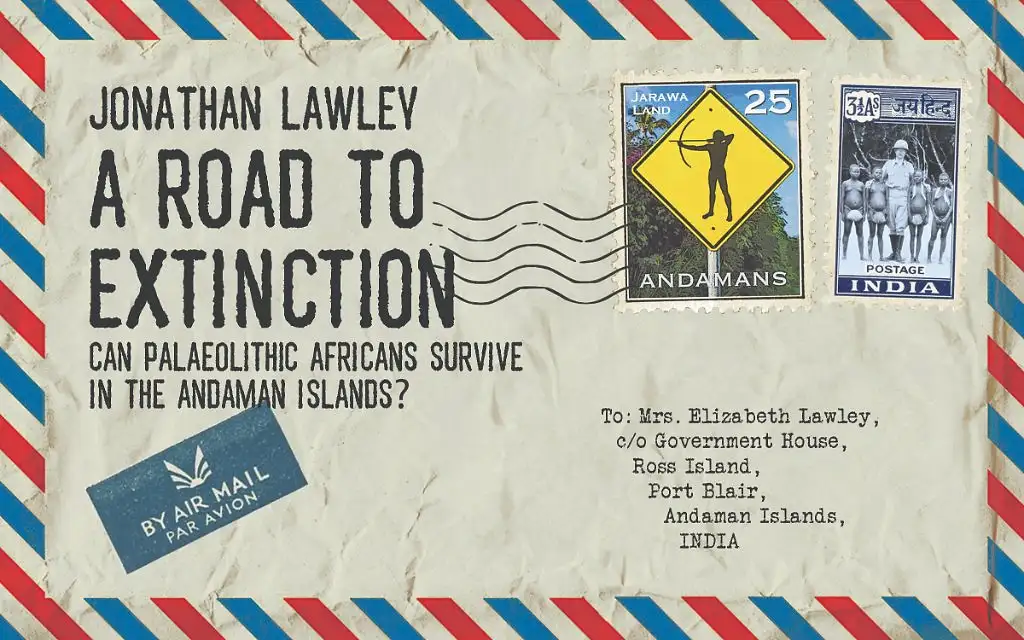
A Road to Extinction: Can Palaeolithic Africans Survive in the Andaman Islands?, first published by Envelope Books in 2020, takes up a quite different subject but is closely connected to Lawley’s earlier concerns. The book examines the Jarawa, an indigenous hunter-gatherer people of the Andaman Islands, and the consequences of the Andaman Trunk Road, which passes through their territory. Lawley argues that increased access has brought tourism, unwanted contact and pressure towards assimilation, threatening a society that had maintained considerable independence from the outside world.
Lawley interesting occupies a position within the history he describes. His career encompasses British India, colonial Africa, African independence, post-colonial business and, finally, the retrospective examination of another part of the former British Empire. A Road to Extinction can consequently be read not only as a book about the Jarawa but also as the late work of someone reconsidering, documenting and in some ways revaluing the assumptions of the world in which he was brought up and served. His authority derives less from formal academic credentials than from ‘long experience of colonial administration, Africa and the encounter between Western institutions and societies whose values differ fundamentally from their own’. His resulting perspective is distinctive, offering historical and anthropological claims built on experience.