We use essential cookies to keep this site working — your cart, your accessibility settings, your preferences. We don’t use tracking or advertising cookies. Read our Cookie Policy.

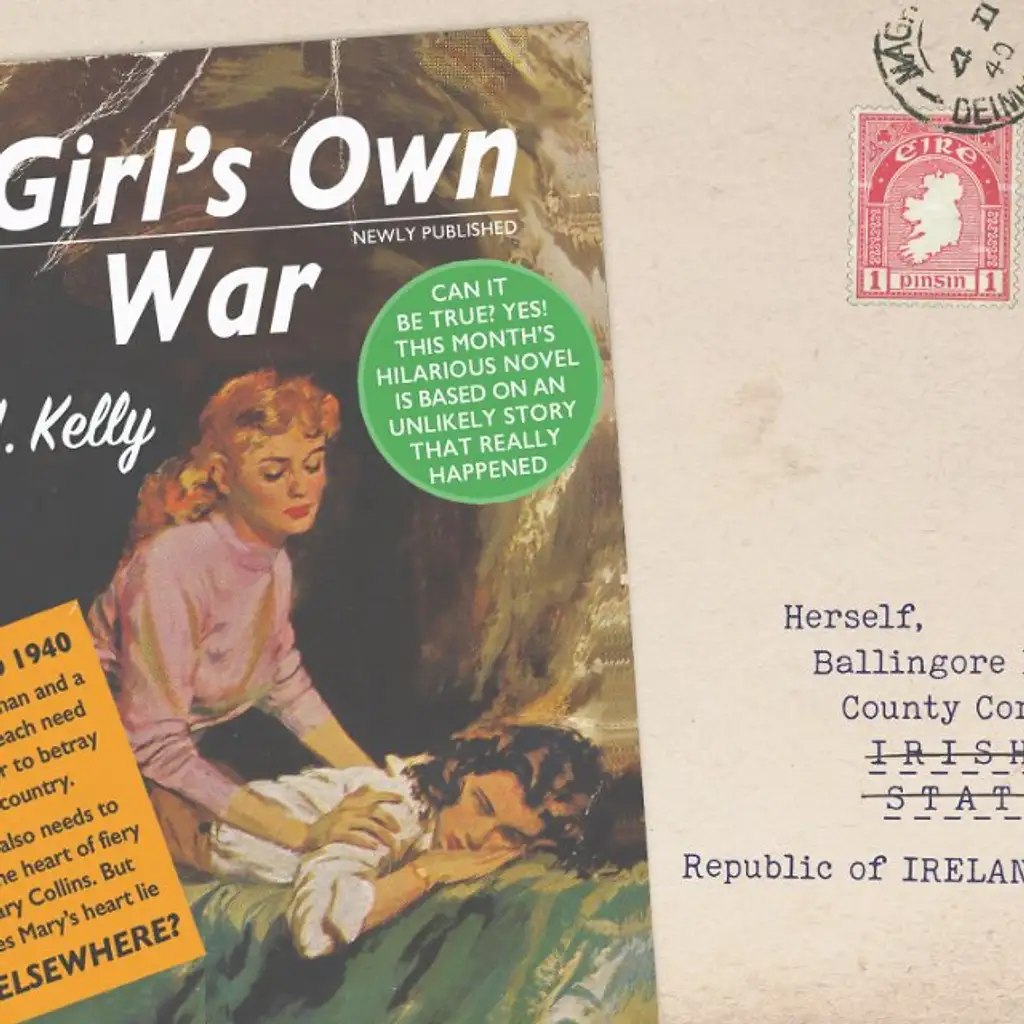
A Girl’s Own War
KJ Kelly
- Publication date
- 7 Sept. 2023
- Print length
- 246 pages
- Paperback ISBN-13
- 9781915023148
- Dimensions
- 203 × 127 mm
- GoodReads
- Customer reviews
A Girl’s Own War
Wodehouse meets Waugh meets Carry On in this hilarious debut novel by K.J. Kelly. Among the laughs and capers, there is sweetness and romance. A most unusual Second World War novel taking place in a most unusual wartime setting, A Girl’s Own War is the kind of read we get only once in a decade.
David Baclaski, author
Take one spirited colleen, mix with an Allied and a Nazi soldier both in love with her, add a dash of the ‘love that dare not speak its name’ and shake with gentle nostalgia and whimsy. These are the ingredients of the charming comedy A Girl’s Own War, one of the sweetest books I’ve read this year. Recommended!
Bob Madison, Cash and Carrey, The Lucifer Stone, and Spiked!
About the book
In neutral Ireland in 1940, where wartime combatants live side by side, an Englishman and a German each need the other to betray his country. And if the nationalist firebrands get their way, they may have to fight to the death. But hang on!
Just a few months ago, Flight Lieutenant Oliver Carmichael and Baron Julius von Stulpnagel were living together in Berlin, trying to sell forged paintings. So what are they doing in rundown Ballingore, and how will ex-convent-girl Mary Collins and her devoted red-headed sidekick Niamh Slattery play into their hands? A hilarious Irish farce, with all the slapstick flavour of an Ealing Studios comedy.
Endorsements
No one finds it odder than I do that my first novel, A Girls’ Own War, turned out to be a comedy. It is, after all, set in a deeply troubled time and place and is being read in equally troubling circumstances. Who, in their right mind, finds conflict, poverty and desperation funny?
The novel certainly didn’t start out that way. I have family connections with County Cork, and with good people who put me up during my school holidays and put up with my mischief-making, without ever mentioning a word to my parents. I ran as wild then as I do in my imagination now—and that’s the problem, because my story of a small coastal town near the very southern tip of Ireland in 1940, overwhelmed my usual means of story-telling. And not for a minute would I want to patronise them.
It’s a truism that fact is stranger than fiction. One of my characters in wartime neutral Eire is John Betjeman, who would go on to become Britain’s poet laureate. I could not—or would not—have invented his presence there; I have no wish to create false history. But there he trod, or bicycled, writing to his Irish muse, Emily, commiserating with her being stranded with a “stone-age” people.
There were other equally unlikely but entirely historical characters who washed up on the spit of land that is Ballingore, West Cork. In passing, these included Royal Naval Flight Arm officers who crash-landed and were interned on Ireland’s non-combatant soil, as well as sundry German submariners and the blackmailing brother of Brendan Bracken, Churchill’s parliamentary private
secretary.
As with Prospero’s island, what brought them there—a spell-induced storm or the dogs of war—is mere device. But for a while, a year after the war with Hitler had begun, Ballingore was a dramatic spot, for Britain and for Germany, both deeply involved in the Battle of the Atlantic, and for the people who lived there.
Among them was my father, the wee’st of wee boys in 1940.
If asked, I’d say the inspiration for A Girl’s Own War was the photo of him, in blackface, with a dish of exotic fruit on his turbaned head. He is seen attending upon a group of moustachioed young men, in “Arabic drapes”, performing a pantomime at Ballingore House, the estate of the Anglo-Irish Lord White, who gave bed, board and booze to any Allied airman who unwittingly set foot on Eire’s holy turf. They merely had to sign the guest book and promise not to escape.
My Dad had nowhere to escape to.
Was he traumatised by the experience? He didn’t ever say so and I didn’t delve, for what captured my interest was the dark-eyed young woman, almost out of shot. My old man remembered her, vividly. “That one,” he said, “ran with the hare and mixed with the pack. She loved the chase.” Her name was Mary, he said, and she could be posh and she could be plain, just as it suited.
But always she was ambitious. How those fly boys danced on her attentions.
My attention was piqued, because when I hear the experiences of my parents’ generation, of their childhood in the 40s and 50s in Ireland, there is one constant and compelling refrainti how they negotiated class.
As it happens my folks were from a fragile class in a country that had only recently achieved independence. They were from what used to be known as the petit bourgeois. My grandfather was the master stonemason for Lord White’s estate, which is how my father came to be available for small dramatic parts. And my mother’s people kept shop, providing tea, bacon and mustard on tick to the lower gentry—lower, at least, than Lord White, who was more usually provisioned by Fortnum and Mason, depending upon what the sailing conditions were like.
As for the poor of the town, they had to pay on the nail. That always fascinated me: thems that can don’t have to, thems that can’t can go hang.
Apparently the bills run up by the landowning types turned my granny’s hair grey at thirty. If she quibbled—read, “begged”—they would reply that dumb insurrection by ignorant Fenians had caused the hardship in the first place, provoking “mainland Britain” into its economic blockade of this, John Bull’s other island. The underclass had chosen to unmake the bed, now they must lie in it.
From the reminiscences I recall from boyhood holidays, it seems that the 30s were dire in Southern Ireland, or Eire, or whatever name it had taken since independence in 1926. No meat or cheese headed east across the Irish Sea, and poverty hardened, ossified. One had to cleave to the landed class because they alone might offer some work, and might one day settle their bills.
The result was that a class of poor was rendered more docile than it had been pre-independence. Indeed, it became obvious that Eire was independent in name only. The old land-holding governing class must not be ousted but clung onto to, as a yachtsman must cling to an upturned boat, when miles from shore and in sore need of help.
But then came the Emergency of 1939, the decision to remain neutral, and the demands for food and sustenance from wartime Britain. Up went the prices of beef and butter and money at last began to flow through the veins of the economy and into the pockets of drapers and publicans. On the Atlantic-facing West Coast there was the excitement of the battle of the boats—those of the Allied type that flew and those of the German type that could submerge. Inevitably, men and machine washed ashore.
But what was the cap-doffing stonecutter or the curtseying shopkeeper to do? Keep their bets open, loyalty-wise; that’s how I heard it across the pitched-pine table. Why, it could be swastikas in the town square by teatime, or the Brits might just as readily take back the port they had kept, post-independence, until 1937. It’s a juicy bone to thicken any plot, but my loyalties came to lie elsewhere.
Besides, I knew my parents’ story, as much as any offspring can. They were still alive and I hate hurting anyone’s feelings, even for money. The truth was that by the time I reached my early-middle years, I was smitten by the dark-eyed one—her in the photo, Mary. In her face I saw excitement, intense curiosity and that slight furrowing about the temples that tells me she’s sizing up an opportunity.
And why not? Ballingore was as noisy and bright as a musical in the autumn of 1940—at least in comparison to the pre-war years.
So A Girl’s Own War is the story of the trials and machinations of Mary—let’s call her Collins. Plain Mary Collins. She’ll have to explain the absence of a middle name for I know how much a saint’s or patriot’s moniker prefixing a surname is prized in Ballingore. She’ll be peeved for sure. How to express peevishness? Ah, she’s a convent-educated young woman, of impeccable Catholic tastes and habits, landless but marriageable, desperately seeking sanctuary and sanctity.
Poor Mary: a patriot, obviously, but immune to the charms of the pitchfork. And at nineteen she’d not entirely grown out of schoolyard smut. She’s pious, then, and profane.
How does Mary tell her story? To whom? To me? Heaven forbid, how unsavoury. No, she has a friend—or, rather, she’s made to take a friend, one who is a true child of the very plain people and who cannot help but speak truth to power, who everyone agrees will keep Mary on the straight and narrow but secretly has more ambition than Mary possesses in her middle finger.
She’s smart too, this Niamh Slattery. Imagine having to thread your way through the chicane of small-town gossip and the slick overtures of the Brylcreemed squad, not to mention the sickly doggerel of the English poet. Why, these girls are for the taking, no? Or, at least, for the taking down a peg or two, say the townspeople.
Yes, yes, I invented Naimh to save Mary. It’s my love story too. But I try not to intrude; I let them talk their troubles out in rhyme and riddle. They don’t use standard Irish, or even, Oirish. That’s not what I’m hearing, for these two are wiseacres, throwing out lines to entertain each other. Don’t all close teenage pals have their own language?
Perhaps it is unseemly to listen in but. honestly, I can’t help myself. Mary and Niamh made me write it down so I wouldn’t forget, so I might read their lines back and cheer them on for their pluck, lack of luck and sheer perseverance. Yes, they are oblivious to the great affairs of state and family, but that is the point of being nineteen and being a bit wide-eyed and rather cunning. I have no wish to go back but I still want to remember how it was.
KJ Kelly
I loved it. A Girl’s Own War is an irreverent, hilarious and thoroughly enjoyable romp through history. Mary and Niamh are like a surreal Thelma and Louise, only it’s during WW2 and they’re trying to escape the nuns as much as the Enemy, who might not be an enemy after all, which makes it all the more intriguing. Praise to K.J. Kelly, a fresh, utterly individual voice on the historical thriller scene—and definitely one to watch!
Mara Timon, City of Spies
An unforgettable cast of characters is assembled in an imaginary West Cork port in neutral Ireland during WWII. Together they provide an hilarious farce in which English, German and some Irish characters prove shamelessly unpatriotic. All are possessed of delusional ambitions that create conflicts that keep the story running vigorously and chaotically to the end. But while rich in stereotypical characters, the prime joy concerns the beautiful Mary Collins and her devoted, more intelligent, friend Niamh Slattery—a female twosome that parallels the Shakespearean Lear and his Fool or Don Quixote and Sancho Panza—but funnier. A mid-century Thelma & Louise for the West of Ireland? Kelly has an original voice and considerable erudition, which dances lightly and to good effect throughout the story, with humorous and apposite references. Lyrical passages also abound and certain incidents remind one of George Bernard Shaw’s lines, in John Bull’s Other Island, about the English being so foolish in their cleverness and the Irish so clever in their foolishness.
A smile on every page and often a laugh.
Barry Walsh, author of The Pimlico Kid
KJ Kelly
About the author