We use essential cookies to keep this site working — your cart, your accessibility settings, your preferences. We don’t use tracking or advertising cookies. Read our Cookie Policy.


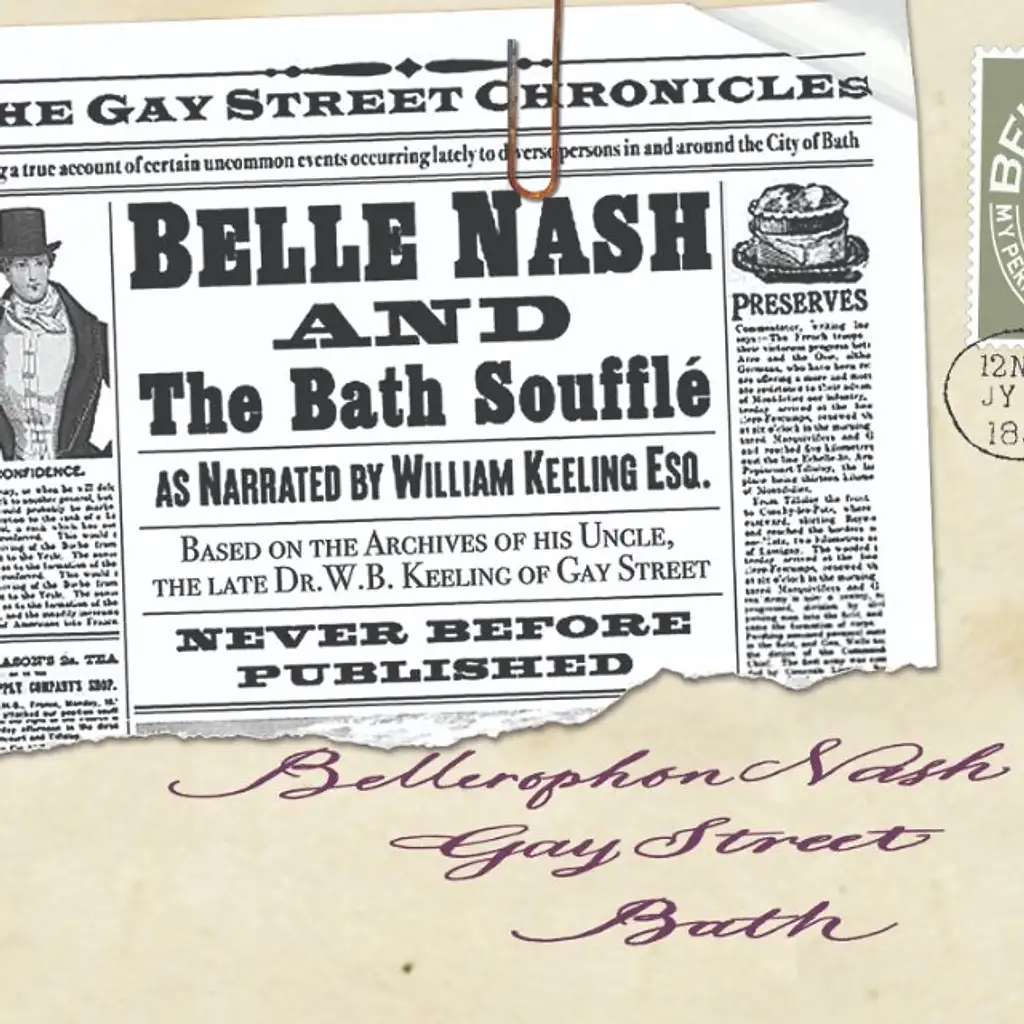
Belle Nash and the Bath Soufflé
William Keeling
- Publication date
- 3 Mar. 2022
- Print length
- 290 pages
- ISBN-13
- 9781915023025
- Dimensions
- 203 × 127 mm
£9.99
Belle Nash and the Bath Soufflé
Alexander McCall SmithA real romp of a book – full of surprises!
Jeanette WintersonFunny, clever, silly in the right way, and strangely moving in its unexpected ending. I love the alt-Regency Bath that Keeling has built.
About the book
Welcome to The Gay Street Chronicles! When Mrs Gaia Champion hosts her first supper after the untimely death of her adored husband Hercules, the meal goes sadly awry. Enter gay hero Bellerophon “Belle” Nash: city councillor, grandson of Bath’s original Master of Ceremonies Beau Nash, and bachelor extraordinaire. Assisted by a group of eccentric lady friends, Belle sets out to explore Gaia’s culinary mishap, only to expose a web of corruption that goes to the heart of Regency Bath’s judicial system. In doing so, he struggles to retain the commitment of his German “cousin”, and Princess Victoria—not yet Queen—persuades Gaia that all women can defeat the bonds of male repression.
Belle Nash and the Bath Soufflé was first published in 2022 by EnvelopeBooks. It is the first volume of The Gay Street Chronicles, a projected series set principally in Regency and early Victorian Bath. Its main character is Bellerophon ‘Belle’ Nash, a gay bachelor, local councillor and grandson of Bath’s celebrated eighteenth-century Master of Ceremonies, Beau Nash. In the story, a failed soufflé at a dinner party precipitates a chain of events involving corruption, sexual politics, social hypocrisy and the city’s judicial establishment.
The novel’s method is deliberately anachronistic. Keeling takes the manners, institutions and social hierarchies of the nineteenth century and subjects them to a distinctly modern sensibility. Gay identity, feminism, sexual politics and corruption are placed within a whimsical Regency setting, while the characters are treated with considerable affection. The result is not historical realism in the conventional sense. Bath becomes an alternative Regency world in which the absurdities of contemporary life can be refracted through period manners.
This helps to explain the comparison with P. G. Wodehouse, whom Keeling cites among his influences, alongside Armistead Maupin. The Wodehouse influence is apparent in the names, comic complications, eccentric secondary characters and delight in social absurdity; Maupin’s influence is more evident in the openness with which sexuality and unconventional relationships are incorporated into the fictional community.
The novel nevertheless has a serious political dimension. Beneath the farce are questions concerning the position of women, the abuse of institutional power, sexual freedom and the arbitrary nature of social convention. Princess Victoria appears as a character, and the novel’s feminism is intentionally playful rather than doctrinal. Its historical setting allows contemporary arguments to be displaced into an apparently safer comic world.
The book received unusually strong endorsements for a first novel. Jeanette Winterson described it as ‘funny, clever, silly in the right way, and strangely moving’, while Matthew Parris praised the series as both ‘incisive’ and ‘hilarious’. Sir Ian McKellen has also described the Gay Street Chronicles as ‘perfect weekend reading’.
Endorsements
Matthew ParrisBy turns incisive, outlandish and hilarious!…there’s a brilliance in The Gay Street Chronicles, half-modern, half-Dickensian.
Peter TatchellBravo. A rollicking tale of corruption, intrigue and romance. A racy read!
William Keeling
More from this author